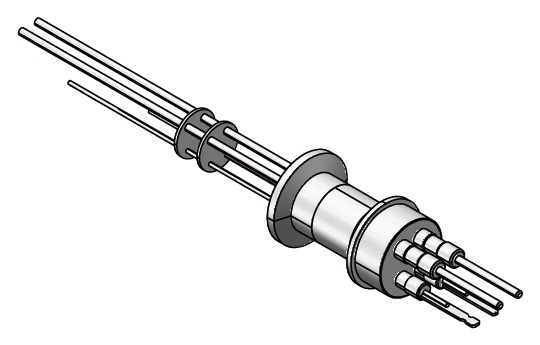
A vacuum feedthrough must transfer power, signals or fluids across a vacuum boundary without compromising vacuum integrity. With dozens of flange types, pin counts and voltage classes available, selection can feel overwhelming. This guide walks through the decisions in order of impact.
1. Define the Electrical Requirements First
Start with the operating envelope, not the connector brand:
- Voltage: 1 kV, 5 kV, 8 kV, 20 kV, 30 kV… The higher the voltage, the longer the creepage path along the ceramic surface and the larger the required insulator spacing. Corona and arcing are driven by geometry and pressure, not just the rating.
- Current: Amperage determines conductor cross-section. High-current feedthroughs (95–800 A class) use copper tubes and forced cooling considerations; signal-level pins use small nickel or gold-plated pins.
- Frequency / impedance: For RF and data, choose a controlled-impedance coaxial feedthrough (50 Ω, BNC/SMA/SHV families) rather than a power pin.
2. Choose the Flange and Mounting
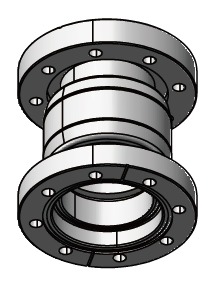
In UHV work, CF (ConFlat) flanges with copper gaskets are the standard for metal-sealed, bakeable joints. KF (ISO-KF) quick-connect flanges with O-rings suit high-vacuum and moderate-temperature applications where fast assembly matters. Match the feedthrough flange to your chamber port — CF16, CF35, CF63, CF100 and CF160 are the common sizes. Never adapt down from a larger port without checking the seal diameter.
3. Conductor and Body Materials
- Copper: best conductivity for high current; must be derated at bakeout temperature.
- Nickel: good all-round conductor, weldable, moderate cost.
- Molybdenum: low expansion, ideal where CTE matching to ceramic matters.
- Kovar: standard for coaxial and instrumentation seals.
- Stainless steel body: UHV-compatible, non-magnetic options available for electron-beam and magnetic-sensitive applications.
4. Environmental and System Constraints
- Bakeout: UHV systems are baked at 150–400 °C. Ensure the feedthrough temperature rating covers your bakeout schedule, including the air-side connector.
- Radiation / magnetic fields: choose non-magnetic materials and radiation-tolerant ceramics for accelerators and fusion systems.
- Vibration and flexing: where the cable or conductor moves, specify a bellows-protected design or flexible interlayer.
5. Standard vs Custom
When a standard model fits, it saves cost and lead time. When it does not — unusual pin counts, combined power and thermocouple pins, special lengths — a custom ceramic-metal feedthrough is often the better engineering answer. The best suppliers quote custom work from the same metallization and brazing processes as their standard range, so quality is not a compromise.
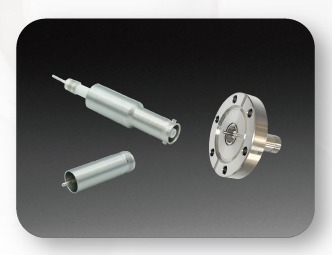
Browse our power feedthroughs, coaxial feedthroughs and multipin connectors, or send us your requirements and our engineers will recommend a solution.