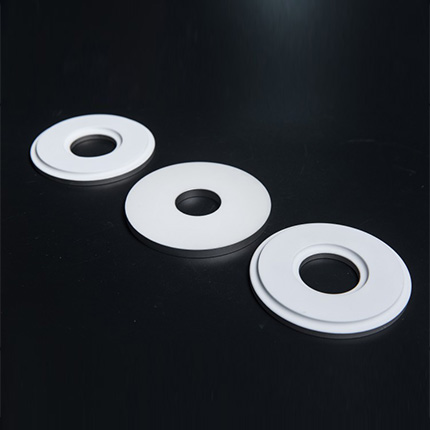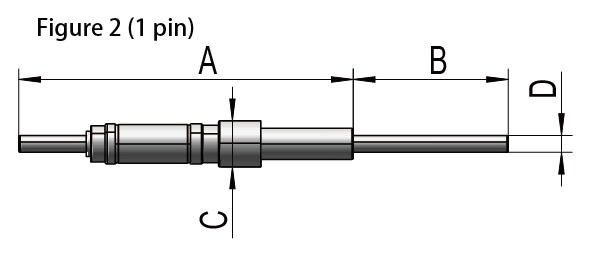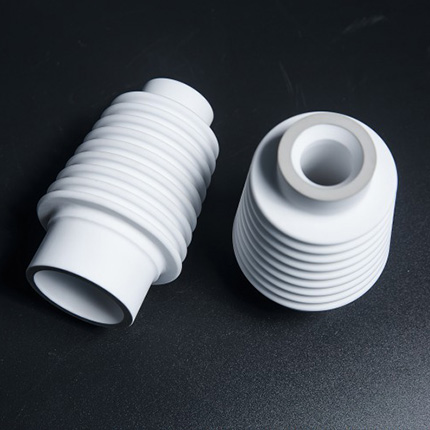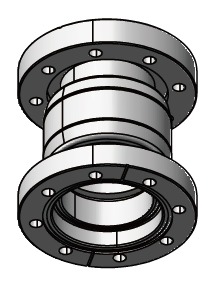
Nearly every vacuum component starts with a material decision: which ceramic? Alumina is the default, but AlN and sapphire earn their place in demanding applications. Here is an engineer's comparison.
Alumina (Al₂O₃) — the Reliable Default
Available in 95%, 96%, 99% and 99.7% purity grades, alumina offers an outstanding balance of properties at a competitive price:
- Volume resistivity above 5×10¹⁵ Ω·cm and dielectric strength above 40 kV/mm — ideal for feedthrough insulation.
- Flexural strength over 300 MPa and hardness that resists abrasion.
- Service temperature to 1600 °C in many grades.
- Well-understood Mo-Mn metallization, which is why 95–99.7% alumina dominates ceramic-metal sealing.
Aluminium Nitride (AlN) — for Heat
AlN conducts heat like metal: its thermal conductivity reaches 170–230 W/(m·K), roughly 10× that of alumina, while remaining an electrical insulator. This makes it the ceramic of choice for power electronics, RF amplifier packages and semiconductor processing components where heat must leave the device.
- CTE is a good match to silicon, reducing thermo-mechanical stress in chip packaging.
- Requires active metal brazing or careful metallization — Mo-Mn does not bond well to AlN.
- More expensive and harder to machine than alumina.
Sapphire — for Optics and Harsh Conditions
Sapphire is single-crystal α-Al₂O₃. It transmits from 180 nm (deep UV) to 5000 nm, resists chemical attack and is extremely hard. Sapphire viewports appear in high-temperature, high-corrosion and optical vacuum systems, and sapphire windows can be metallized and brazed like other ceramics.
Quick Selection Table
| Property | Alumina 95–99.7% | AlN | Sapphire |
|---|---|---|---|
| Thermal conductivity | ~20–30 W/(m·K) | 170–230 W/(m·K) | ~40 W/(m·K) |
| Resistivity (25 °C) | >10¹⁵ Ω·cm | >10¹³ Ω·cm | >10¹⁶ Ω·cm |
| Optical range | Opaque | Opaque | 180–5000 nm |
| Metallization | Mo-Mn, thin film, AMB | AMB preferred | Mo-Mn, thin film |
| Relative cost | $ | $$$ | $$ |
A Practical Guideline
- Default to 95–99.7% alumina for most feedthroughs, insulators and structural parts.
- Switch to AlN when junction temperature is the constraint and you need to move heat through an insulator.
- Choose sapphire for optical viewports, or when abrasion and chemical resistance dominate.
Our precision ceramic series covers alumina, AlN, zirconia and more, machined to ±0.01 mm. Need help selecting a material for your application? Contact our engineers.